What Belongs on a Hotel Maintenance Checklist
A hotel maintenance checklist can help FM teams track, monitor, and audit exactly what needs to happen and how often across hotel venues. But what these checklists often lack is clarity around responsibilities.
Hospitality maintenance is known for having some of the most demanding requirements, but hotels in particular face especially challenging conditions. With round-the-clock occupancy, broad asset environments, and little to no downtime window, maintenance schedules have to be precise and well-sequenced.
With layered ownership between owners, management companies, brands, and FM providers, it’s easy for maintenance responsibilities to blur, increasing the risk of task duplications and unnecessary costs. From daily to statutory maintenance, hotel FM teams need total peace of mind that maintenance isn’t just carried out, but can be evidenced.
At SFG20, we work with hotel and hospitality FM teams, operators and service providers across estates ranging from budget franchises to luxury and landmark properties, all-inclusive resorts and holiday parks. Here is a round up of exactly what a hotel maintenance checklist should cover, and how to decide where each responsibility lies for total compliance and operational efficiency.

What should a Hotel Maintenance Checklist Cover?
Hotels and hospitality venues sit across some of the broadest asset environments. In hotels specifically, buildings span bedrooms, plant rooms, bars, commercial kitchens, event spaces, leisure facilities, lifts, and even outdoor infrastructure. A hotel maintenance schedule that reflects only the guest-facing parts of that estate will leave the brand open to a significant amount of risk.
With no downtime window to fall back on, the hotel preventive maintenance checklist has to make sequencing explicit. Broadly, the tasks can be bucketed into three frequencies.

Daily Maintenance Tasks
A hotel daily maintenance checklist will consist of checks that depend on daily site presence and operational familiarity rather than specialist engineering skill. Many of these will overlap with a hotel room maintenance checklist, including tasks such as:
- Ensuring that there’s hot water in guest rooms
- Caulking repairs and plumbing issues
- Checking thermostat control and functionality
- Checking HVAC filters are clean
As well as broader property checks such as:
- Checking pool chlorine and pH levels
- Ensuring lifts are in service and working properly
- Maintaining landscaping, parking areas, and on-site aesthetics
The value here is early warning. Guestroom water temperature issues, HVAC complaints, and out-of-service lifts can all be noticed on-site long before they appear in a planned maintenance visit. These checks can be performed daily by on-site management teams to ensure the guest experience - and the venue’s reputation - stay intact.
Many of these daily maintenance tasks also apply to other hospitality venues. For example, restaurants will need to regularly check hot water, bathroom facilities, and HVAC filters, among other daily checks.
Monthly Maintenance Tasks
This is the planned maintenance layer, covering the assets most important for safe, uninterrupted guest experiences and operations. Typically these tasks can include:
- Servicing HVAC and ventilation systems
- Hot and cold water services
- Lift and escalator safety inspections
- Fire safety system checks
- Power distribution and emergency lighting maintenance
- Pool plant and water treatment
- Mechanical systems maintenance
For food and beverage sites, the checklist expands to include the maintenance of commercial kitchen extractions, canopy hoods and ductwork, grease taps, gas appliances, and commercial refrigeration and freezers.
Frequencies in this layer are where a lot of avoidable costs sit. Applying the same intervals across every property is a common source of inefficiency in hotel portfolios, where a full-service city-centre hotel, a budget roadside property and a leisure resort may all have very different maintenance demands. Frequency should reflect occupancy levels, hours of operation, asset age and condition, and factors such as footfall, coastal exposure, and humidity.
Statutory Maintenance Tasks
Statutory maintenance exists to ensure compliance with legal requirements. For example, hotels and hospitality venues are among the highest-risk environments for Legionella bacteria, particularly in more seasonal properties.
The occupancy pattern is what makes this sector distinctive. In hotels where guest rooms with showers, baths and basin taps go unused for days or weeks at a time, water left undisturbed risks becoming stagnant - and this extends across spa pools, hot tubs, cooling towers and decorative water features.
Food service brings its own compliance layer, with publicly available Food Hygiene Ratings making poor scores just as much a commercial risk as a regulatory one.
Much like any other hospitality venues, a good hotel maintenance checklist ensures that statutory items are visible and clearly assigned, so that teams can treat them with the appropriate rigour and evidence trail to minimise risk of compliance exposure.
The most straightforward (and common) form of tailoring is excluding tasks that aren’t applicable because the relevant asset, component or feature simply isn’t present.
Example: 10-01 Cold Rooms Task 24 (RED Criticality) Automatic leak detection system (if installed). This task can be removed if the system is not present on the asset.
What matters here is the evidence. If you remove non-applicable tasks, you should document the basis for removal. For example, asset register evidence, site survey findings, and scope confirmation.
Which Checks Belong to the Site Team vs the FM Provider?
This is one of the most important considerations for hospitality environments, particularly where a management company operates a property on behalf of a third party owner.
What determines the allocation of facilities management responsibilities isn’t seniority or cost, but a practical assessment of what each task actually requires:
- Which tasks require specialist engineering skill? These sit with the FM provider to minimise risk and unnecessary costs.
- Which checks depend on daily site presence or operational familiarity? These will typically sit with the on-site team as they are best informed on how the property runs on a daily basis.
- Which activities are better managed by the general manager? Some oversight and coordination naturally belongs with the person accountable for the property as a whole.
- Where does the FM provider’s scope begin and end? If that boundary can’t be stated plainly, it risks being interpreted differently by different parties.
A well-allocated hotel maintenance checklist makes responsibilities as well as tasks clear for everyone involved, including the FM provider, management company, and property owner.
When that fails to be documented, the same two problems continue to appear: activity in some areas gets duplicated, while gaps open in others. Both raise costs, but only one of them risks commercial and reputational damage.
Building a Hotel Maintenance Checklist from a Recognised Standard
SFG20 is the recognised industry standard for maintenance that helps FM teams and property managers define how maintenance, repairs, and safety checks should be carried out for maximum efficiency and compliance. The official guidelines provide a benchmark that teams can then use as a trusted starting point that carries credibility with owners, brand auditors, statutory authorities and insurers.
From there, the checklist gets tailored around the property and how its operations run on a daily basis:
- Confirm what applies. Not every task will be relevant to every building. Non-applicable tasks should be removed, and tasks reflecting the specific asset profile of the property should be added, so the schedule is a genuine reflection of the site rather than a generic template.
- Review criticality. While some tasks support legal and statutory compliance, others protect guest safety and comfort, or protect asset value and owner return. A hotel maintenance checklist should take prioritisation into account.
- Set frequencies deliberately. Where frequency is open to judgement, the decision should be based on operational reality.
- Record the reasoning. A strong approach records what changed, why it changed, who approved it, what evidence was used, and when it will be reviewed.

Tailored Hotel Maintenance Schedules for every property type
When no two properties are the same, there is no one-size-fits-all for hotel maintenance schedules. With Facilities-iQ, SFG20 gives hotel and hospitality organisations a trusted framework for planned maintenance, and a structured way to decide what should be maintained, how often, which tasks are most critical, and how responsibilities are clarified - all seamlessly integrated with your current FM systems.
Importantly, it provides a baseline rather than a rigid template. The outcome is a maintenance model that works commercially for everyone involved. Clients and owners get an approach that better reflects their properties, compliance obligations, and budget. Meanwhile service providers and management companies get a scope that is clearer, more efficient, and more commercially workable, making it the ultimate win-win scenario for all parties.
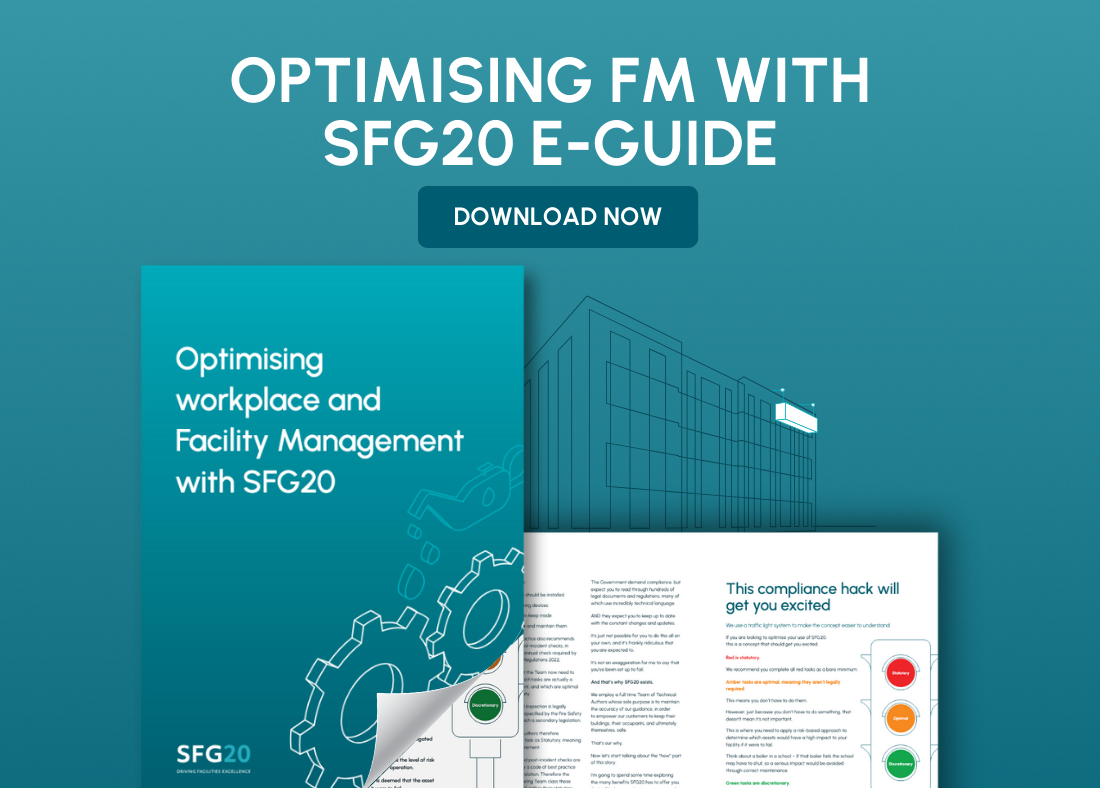
If you’re reviewing your current maintenance approach and aren’t sure where your current gaps lie, our e-guide for hotel and hospitality FM teams includes a full 25-point checklist covering all of this in detail, helping you to better understand your hospitality environment, clarify ownership and responsibilities, and use criticality to support frequency decision-making.
Download the full guide or speak to our team about how SFG20 can support your organisation.